| Braderie |  |
 |
As for the Braderie, it is fair to say that Lille is the setting for one of France's most picturesque events still to take place in France, since it dates back to time immemorial.
The Lille magistrate gave an order wich is regarded as the birth certificate of the Braderie, stating that in the month of August 1446, two innkeepers, Gabin Maille and Pierre Tramart, seeking "to provide meat to people present at the event" canvassed and obtained from the deputy burgomaster the right to roast and sell their cooked meats in front of their houses, along the "rue grande Cauchie". Moreover, "to roast" in Flemish is "braaden" and hence this is how the first two "roast meat sellers" (Bradeux) in history were established. Their fabulous idea caught on quickly and trades people of all linds copied them by bringing all their shop wares out onto streets soon to be joined by fourniture, odd items of clothing and "unwanted goods" ressurrected from attics.
In rich families, the job of giving the sales pitch and selling was left to servants, valets and méquennes who took some of the profits. The meaning of the term "brader" soon came to have new sense of "to seel something cheaply", after those who sold "seconds" at giveavay prices.
Today, domestic staff clearly no longer do the selling, that old things are disappearing and that real salespeople, selling new items, are taking thier place.
Note absense of Mussels in Derousseau's description. Althought they were nowhere near as popular as they are now, we nevertheless know courtesy of an article in the "Echo du Nord" of the 6th December 1890 that they were already being sold there. In 1929, Monsieur de Saint Léger was regretful that the traditional cries of the Braderie were no longer heard and that it had become nothing more than an open market but which nevertheless had spread to the whole town, and which drew in a vast number of people.
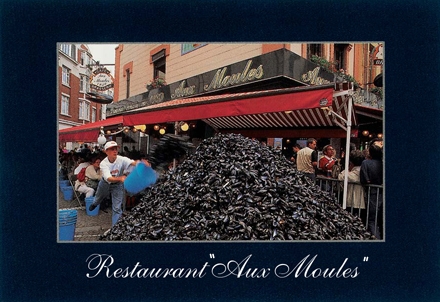
The Braderie of Lille would not be the same now without mussels. How long have mussels been a tradition? Debriève told of its existence as early as 1890 but it was not such a big event then as it today.
The restaurant "Aux Moules" has in recent times certainly helped the growth of this veritable institution. The administration in charge of the road, rail and waterways network used to stipulate that bags must be placed in front of this restaurant in order to clear up all the empty shells, however, year after year, this arrangement was never adequate and the restaurant owners were allowed to throw to throw their empties out into the street.
Editorial by Monsieur Pierre Mauroy - 4th September 1993 |
|
|




